
There is no single global standard for fire-safe fabric. France certifies flexible materials to M1 or M2 under its own classification. Britain tests to BS 5852. The EN 1021 series sets a broader European baseline for upholstered furniture. Marine interiors answer to IMO regulations, and transport, rail and aviation among them, applies its own separate requirements again. A fabric certified under one method doesn't automatically apply to another.
Mublo's fabrics are independently certified for these specialised applications, IMO-certified fabrics for marine use among them, and proposes the right certified article once a project's actual requirement is known.
To make sense of this for commercial upholstery in contract interiors, hospitality, healthcare, workplace, and residential projects, Mublo organises its own range under one simple scale, one to five stars, built to simplify the search. A product's star rating is cumulative: a five-star product has already passed the tests required for four, three, two, and one star. The rating reflects the highest level of fire performance a product has been tested and passed for.
| Rating | Standard |
|---|---|
| ★★★★★ | M1 (NF P92-507) or equal, such as B-s1,d0 |
| ★★★★ | BS 5852 Crib 5 or equal, such as M2 (NF P92-503) |
| ★★★ | EN 1021 Parts 1–2 or equal |
| ★★ | NF EN 1021-1 or equal, such as BS 5852 Part 1 |
| ★ | No fire retardancy tested |
Standards shown are representative. Equivalent classifications recognised under other national systems qualify a product for the same star.
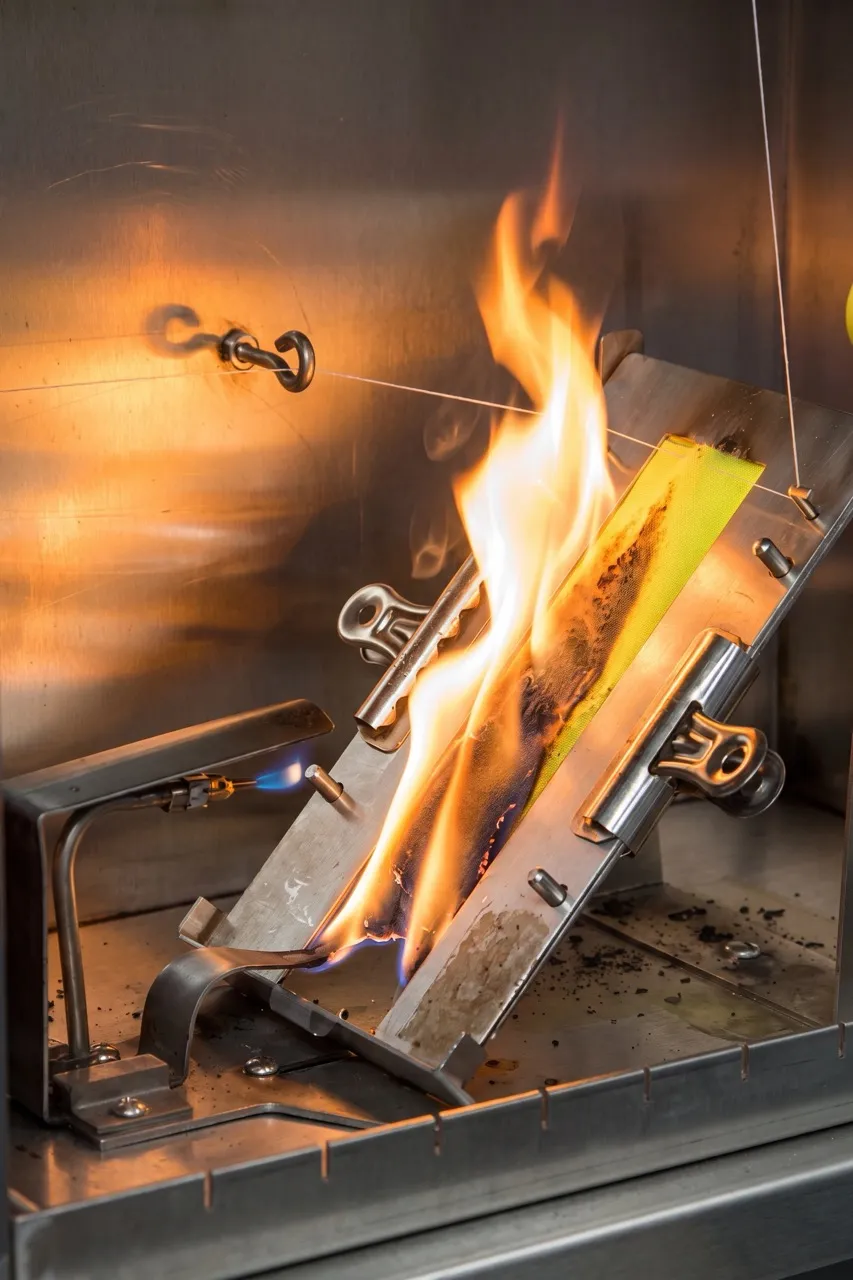
Under NF P92-507, the French classification standard, a fabric is exposed to a flame at an angle, and the result comes down to what happens once that flame source is taken away.
M1, non-flammable, means the material self-extinguishes as soon as the ignition source is removed. M2, slightly flammable, means it keeps burning a little longer before going out. The class is decided by how long the fabric continues to burn after that ignition source is withdrawn, not by whether it ignites at all.
Material type changes which test and which certificate apply. A wallcovering and an upholstery fabric don't face the same fire risk in a room, so they aren't tested the same way, which is exactly why a separate certificate and classification exists for each. A rating on a fabric's technical sheet always refers to the test appropriate to that material and its intended use.
The test itself uses an electric burner, held against the fabric for twenty seconds, then withdrawn. What happens after that contact is what actually earns the classification.
A lab reads five markers from there: how long the flame persists once the burner is removed, whether glowing points spread beyond the area already charred, whether flaming droplets fall from the fabric, how the material behaves as it melts, and the length of fabric destroyed or burned, measured in millimetres. A separate flame-spread test runs alongside it. Each marker is scored on its own, and the class, M1 or M2, comes from the combination of all of them together, not any single measurement read in isolation.
Every project comes with its own fire safety requirements and risk mitigation. Mublo works through the specific certification a project actually requires and proposes the article that meets it.


